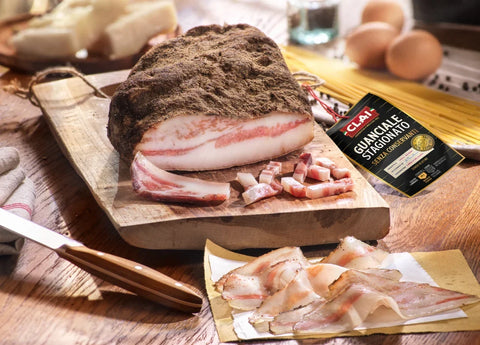

There are cured meats that need no introduction, yet few truly know what makes them different from the rest. Coppa di Parma IGP is one of them: you’ll find it on almost every Emilian charcuterie board, and you’ll recognize it by its deep red color and streaks of white fat, but its history and production process deserve more than a slice served in silence.
What is Coppa di Parma IGP?
Coppa di Parma is a cured meat made from the muscular part of the pig’s neck, the muscles connected to the cervical and thoracic vertebrae. This cut includes both muscle and fat in balanced proportions, and it is this structure that gives it the soft texture and delicate aroma that distinguish it from other long-aged cured meats.
The IGP - Protected Geographical Indication - mark was recognized by the European Union in November 2011. It protects the designation and guarantees that production and aging take place according to a precise set of specifications in a defined geographical area that includes the provinces of Parma, Reggio Emilia, Modena, Mantua, Pavia, and certain areas along the Po in the provinces of Cremona and Lodi.

Where on the pig does the coppa come from?
The coppa cured meat takes its name from the anatomical part from which it comes: the neck, known as "coppa" in many areas of Italy. The cut consists of the muscular part of the neck, namely the muscles connected to the cervical and thoracic vertebrae, carefully trimmed, separated, and trimmed. An untransformed coppa weighs approximately 2.7–3 kg.
The fat is distributed particularly evenly among the lean muscle fibers in this cut, and this is one of the elements that defines the quality of the finished product: a well-aged coppa shows a bright red color in the lean part and a luminous white in the fat when sliced, with a clear transition and no gray areas.
How is Coppa di Parma IGP produced?
The processing follows stages defined by the specifications, which guarantee consistency and typical organoleptic characteristics.
Salting
The cut is trimmed and placed to salt with natural flavorings, including wine. The process involves frequently massaging the piece of meat to promote salt absorption and lasts from 6 to 10 days. The coppa is then placed in refrigerated rooms to mature for another 5 days.
Stuffing and tying
Once the salting phase is complete, the coppa is placed in a natural casing and tied by hand with hemp cords. This manual tying, which runs along the entire length of the coppa at regular intervals, is one of the product’s characteristic visual elements and helps maintain its shape during aging.
Aging
Aging takes place at temperatures from approximately 12 to 16°C and with relative humidity levels of 70–87%, conditions that allow for a slow and gradual reduction in moisture and the development of the biochemical processes that guarantee typical organoleptic characteristics. The minimum aging period is 60 days for coppa weighing 2 to 2.6 kg and 90 days for heavier pieces. Superior-quality products are often aged much longer: from 4 to 6 months, and up to 9 months in the case of a high-humidity microclimate typical of the northern province of Parma.
It is precisely the climate of the Po Valley and surrounding hills—fog, high humidity from the Po, and temperature fluctuations between summer and winter—that makes this area particularly suitable for aging coppa. It is a connection to the land that the IGP mark recognizes and protects.

How to recognize a good coppa
When sliced, Coppa di Parma should have a bright red color in the lean part and a luminous white in the fat, with no gray or brownish areas. The texture should be generally uniform throughout the interior and exterior, indicating gradual dehydration and proper aging. The slices should be soft and never dry.
The aroma should be delicate, with a characteristic fragrance. A coppa that is too dry or produces crumbling slices has probably not been aged optimally.
The ingredients of Coppa di Parma IGP are: pork, salt, dextrose, spices, garlic, natural flavorings, antioxidant E301, preservatives E252 (potassium nitrate) and E250 (sodium nitrite). The IGP specifications permit them because they serve a precise technical function: nitrites inhibit bacterial proliferation during aging and contribute to the characteristic red color of the slice, while antioxidant E301 (vitamin C) protects the fat from oxidation.
Those looking for cured meats without preservatives can choose other products from the CLAI selection, such as the aged guanciale or the Imola 1962 salami, both without nitrites or nitrates.
Coppa di Parma and other types of coppa
There are several types of coppa in Italy. In general, it is a very popular cured meat in Italy, and every region has its own typical version: depending on the area of production, it is known by different names, including capocollo, lonza, or lonzino.
Coppa di Parma IGP stands out because of its protected geographical designation, which restricts production and aging to a set of specifications verified by third-party bodies. There is also Coppa Piacentina DOP, with an even more restrictive designation that also includes the origin of the raw material. For buyers, the IGP mark is a guarantee of traceability and compliance with defined standards.
How to use coppa in cooking
Coppa works well both raw and cooked. Raw, it is perfect on a charcuterie board, sliced thinly and served at room temperature—never straight from the refrigerator, as the fat must be soft to release its full aroma. It pairs well with dry white wines such as Franciacorta Brut, Colli di Parma DOP Malvasia, or Pinot Grigio.
In the kitchen, it lends itself to uses that may surprise those who only know it as a sliced cold cut:
- On warm crostini with a vegetable pâté—the heat gently melts the fat and enhances the aroma
- As a filling for savory tarts and stuffed pizzas, where it holds up well during cooking without drying out
- Wrapped around grissini or fresh figs for a quick aperitivo
- In a risotto or first course as an aromatic note, added at the end of cooking
- On a mixed charcuterie board alongside salami and semi-aged cheeses
A useful tip: take it out of the refrigerator at least 15–20 minutes before serving. Once opened, store it in the refrigerator wrapped in a damp cotton cloth.
How to pair it on a charcuterie board
Coppa has a medium saltiness and a delicate aroma that make it versatile in pairings. On a mixed charcuterie board, it works well alongside cured meats with a bolder character—a fine-grained Milano salami or salsiccia passita with its herbal notes—where the coppa provides a balancing element.
It pairs well with semi-aged cheeses such as Caciotta Toscana Faggiola. If you want some inspiration on how to create a balanced charcuterie board, you can find ideas in the article on how to perfectly arrange a cheese board.
Coppa di Parma IGP in the CLAI shop
In the CLAI shop, you’ll find Coppa di Parma IGP in two sizes, both with a visible slice and vacuum-packed to ensure freshness during refrigerated shipping. Made from pigs born, raised, and slaughtered in Italy.
- Whole Coppa di Parma IGP—approximately 800 g
- Half-Vacuum-Packed Coppa di Parma IGP—approximately 800 g, ideal for occasional use
Discover Coppa di Parma IGP in the shop