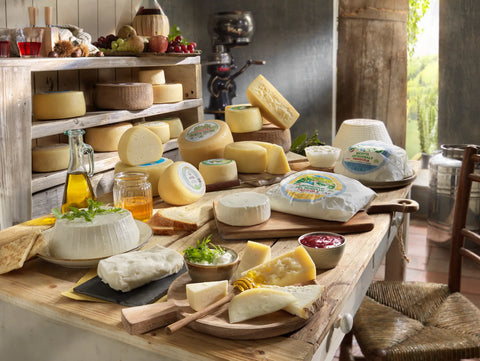
There's something instinctive about how we approach a cheese board. Our eyes dart from one shape to another, our hand reaches out almost reflexively, and our nose starts working even before we taste. It's an ancient ritual, deeply rooted in Italian gastronomic culture, and like any respectable ritual, it's worth doing well.
At CLAI, we approach cheese with the same care we dedicate to cured meats: a controlled supply chain, selected raw materials, and processes that respect time. When we offer a selection of cheeses, we're not just putting products together; we're telling the story of a territory, a season, a method.
Cheese Board: How to Assemble it Perfectly
A good cheese board isn't improvised, but it's not complicated either. The basic logic is simple: variety, balance, progression. What you want to avoid is a selection that all tastes alike, where one cheese overwhelms another without a unifying theme.
Our starting point is always the diversity of texture and aging. A well-constructed board should have at least one fresh or soft cheese, one medium-aged, and one aged. Each tells a different stage of milk transformation, and together they create a meaningful journey.
Among the cheeses in our selection, Caciotta Toscana is one of the most versatile choices to start a board. Compact but still soft, with a sweet and milky flavor and a slightly herbaceous finish, it's the kind of cheese that makes everyone feel at ease, whether they're experienced palates or new to structured tasting. The organic version, made from certified milk, brings an even cleaner, almost herbaceous note, directly reflecting the pasture.
Alongside the caciotta, the Formaggio Misto adds complexity: the combination of cow's and sheep's milk creates a more intricate aromatic profile, with that savory hint typical of well-made mixed cheeses. It's the kind of cheese that balances the board between sweetness and personality.
For the more aged component, Pecorino Stagionato is the natural reference. Granular texture, strong aroma, long persistence: it sits at the end of the journey, when the palate is ready for greater complexity. Sliced thinly, it also pairs well with a drizzle of chestnut honey or a pear jam. The bitterness of the honey balances the saltiness of the pecorino precisely, not randomly.
Some practical rules for assembling the board:
- Arrange the cheeses clockwise from freshest to most aged. Tasters will naturally follow this order without you having to explain anything.
- Bring the cheeses to room temperature at least 30 minutes before serving. A cold cheese from the fridge expresses nothing: the aromas are locked in, the texture is stiff, the taste is flat.
- Don't slice everything in advance. Hard cheeses hold up well, but fresher ones dry out and lose their aroma. Slice as you go, or leave whole pieces with a dedicated knife.
- Accompany with elements that bridge, not contrast. Wildflower honey, fruit mustards, walnuts, some dried figs: elements that amplify the cheese, not cover it.
Cheese and Wine Pairings: A Complete Guide
The pairing of cheese and wine is one of those topics where theory helps, but direct experience counts for much more. There are principles that almost always hold true, and there are exceptions that brilliantly contradict them. The goal isn't to rigidly follow rules, but to understand the logic behind combinations that work.
The fundamental principle is that of intensity matching: a delicate cheese calls for a delicate wine, while a structured and aged cheese can handle, and indeed demands, a wine with body and persistence. When the weights are not equal, one of the two dominates, and the pairing loses its meaning.
Let's start with Caciotta Toscana. It's a cheese that doesn't like to be overwhelmed. Dry, fresh, medium-bodied white wines are its natural territory: a Vernaccia di San Gimignano, a Tuscan Vermentino, or even a Ribolla Gialla from Friuli. If you prefer red, stick to a young Chianti, not aged in wood. The structure is right, the fruit is present, and the tannins are not yet aggressive.
The Formaggio Misto has more personality and holds up better to medium-bodied reds. This is where our Campo di Mezzo, Sangiovese di Romagna D.O.C. Superiore from Cantine Tremonti comes in. A red wine born between the municipalities of Imola and Forlì, from 100% Sangiovese di Romagna grapes: intense ruby color, aroma of ripe red fruits with spicy and balsamic nuances, structured taste but with balanced tannins that don't overpower. It's a wine that knows its territory because it grew there, and it pairs with the Formaggio Misto with a coherence that needs no explanation: the savoriness of the pecorino finds its natural counterpart in the fruit of the Sangiovese, without either dominating. If you want to stick with white, a Greco di Tufo with its minerality and body still goes in the right direction.
With Pecorino Stagionato, the situation changes. The savoriness accumulated during aging demands a wine with real structure. Campo di Mezzo also holds up well to this comparison, especially if the pecorino isn't excessively aged. For more mature forms, a dry Zibibbo from the Sicilian islands or a lightly sweet Passito creates one of those unexpected pairings that leave a lasting impression: the residual sweetness of the wine balances the saltiness of the cheese in a way that leaves a mark.
One last thing about sparkling wine pairings: Franciacorta and Trento DOC, thanks to their lively acidity and structure provided by the classic method, pair well with almost the entire range of fresh and medium-aged cheeses. If in doubt, a quality Italian sparkling wine is often the safest and most elegant choice.
- Caciotta Toscana: Vernaccia di San Gimignano, Vermentino, young Chianti
- Caciotta Biologica: Müller Thurgau, Pinot Grigio, Franciacorta Blanc de Blancs
- Formaggio Misto: Campo di Mezzo Sangiovese di Romagna D.O.C. Superiore CLAI
- Pecorino Stagionato: Campo di Mezzo Sangiovese di Romagna D.O.C. Superiore CLAI
-
Pecorino Faggiola: Verdicchio dei Castelli di Jesi, Trebbiano Toscano, Rosso di Montalcino

Cheese Tasting: How to Organize a Perfect Evening
A tasting evening doesn't require special equipment or sommelier training. It requires care, a logical order, and a willingness to pay attention to what's in your glass and on your plate. It's a slow kind of conviviality, which takes its time, and always leaves something to remember.
The first thing to decide is the format of the evening. You can organize a vertical tasting, focusing on a single cheese at different stages of aging, or a horizontal tasting, where you compare different cheeses with similar characteristics (all pecorino, all mixed milk, all medium-aged). The vertical format is more didactic, the horizontal is more convivial. For a dinner with friends who are new to it, the latter works better.
With our selection, a horizontal tasting evening could be structured like this:
First round, fresh and delicate cheeses: start with Caciotta Biologica and Caciotta Toscana. Same style, different raw materials. Taste them side by side and look for the difference: the organic generally has a more pronounced herbaceous note, the Tuscan is rounder. In this round, the wine is fresh, light, and for serving.
Second round, medium complexity: enter the Formaggio Misto. This is where the real tasting begins, where the palate starts to reason. The pecorino component is felt, but doesn't yet dominate. The wine increases in structure.
Third round, aging: Pecorino Stagionato concludes the journey. Drier paste, visible tyrosine crystals. Those small white spots seen in the paste are a sign of advanced aging, not a defect. The taste is long, decisive. The wine is red, structured.
Some practical things that make a difference:
- Prepare a simple tasting sheet with the names of the cheeses, the milk used, the aging period, and a couple of lines of description. No need to be technical: just give your guests a starting point for thinking.
- Use a neutral glass for each wine, don't mix whites and reds in the same glass. The perception changes completely.
- Serve still water between tastings, not sparkling. Bubbles alter the perception of the next taste.
- Allow for silence: the first few seconds after a taste are the most interesting. First comes the immediate taste, then the persistence, then the aftertaste. Don't immediately fill that silence with words.
There's an aspect often overlooked in home tastings: storage before the evening. Hard cheeses keep well wrapped in cheese paper (not cling film, which suffocates them) in the least cold drawer of the fridge. Fresh caciotte should be kept in their original wrapper until the last moment. All cheeses should be taken out of the fridge at least thirty minutes beforehand: temperature is the true switch for taste.
Organizing a tasting evening with our cheeses means bringing not only different flavors to the table, but different stories: the territory of Tuscany in the Caciotta, the tradition of pecorino in the aged forms, the care of those who have carefully selected each piece. It's not rhetoric: it's what you taste when the cheese is made well and comes from a supply chain you know.
A Complete Board: When Cheese Meets Cured Meat
There comes a moment in the evening when the cheese board craves company. And that's when cured meats enter the scene, not as filler, but as an additional layer of storytelling. Three products from our supply chain naturally pair with the cheese selection, each with its own precise logic.
The CLAI Salsiccia Passita is the typical Romagna sausage, made with the best 100% Italian lean meats from our farmer-members and cased in natural casings. The aging is short and delicate, designed to achieve a tender and melt-in-your-mouth texture, with easy peelability that makes it convenient at the table. The taste is sweet and delicate, with that immediately recognizable roundness. On the board, it works perfectly alongside fresh caciotte: its softness and the aroma of the natural casing interact with the milky part of the Caciotta Toscana and Biologica without ever overpowering it.
Imola 1962 is a salami without any nitrites or nitrates, the result of over two years of research, coordinated by CRPA of Reggio Emilia and CIRI of the University of Bologna. The name recalls the location and year of CLAI's founding, and from this alone, it's clear that it's no ordinary product. The ingredient list is deliberately short, designed to enhance the quality of 100% Italian, traceable meat. The aging, at least eight weeks in dedicated cells, results in a salami with a sweet and persistent taste, with that discreet complexity that builds over time. On the board, it finds its natural dimension alongside the Formaggio Misto: the balanced savoriness of the salami and the pecorino component of the mixed cheese meet without either one overpowering the other.
The CLAI Sbuccia e Mangia are the most immediate of the three: sweet and delicate salami bites, melt-in-your-mouth, which can be peeled and served whole as an appetizer or sliced thickly with a knife. 100% Italian meat, gluten-free, dairy-free. Their versatility makes them suitable for the entire selection, but it's alongside the Pecorino Stagionato that they find the most balanced pairing. The sweetness of the salami balances the more decisive savoriness of the pecorino, creating one of those simple combinations that work without needing anything else.
If you want to build your cheese board starting from a pre-designed selection, you can discover our cheeses directly on the CLAI shop. You'll find them with the same characteristics you've read about here, and they'll arrive at your home with the same care with which we ship them every day.